Monday, January 20, 2014
Winter Beauty
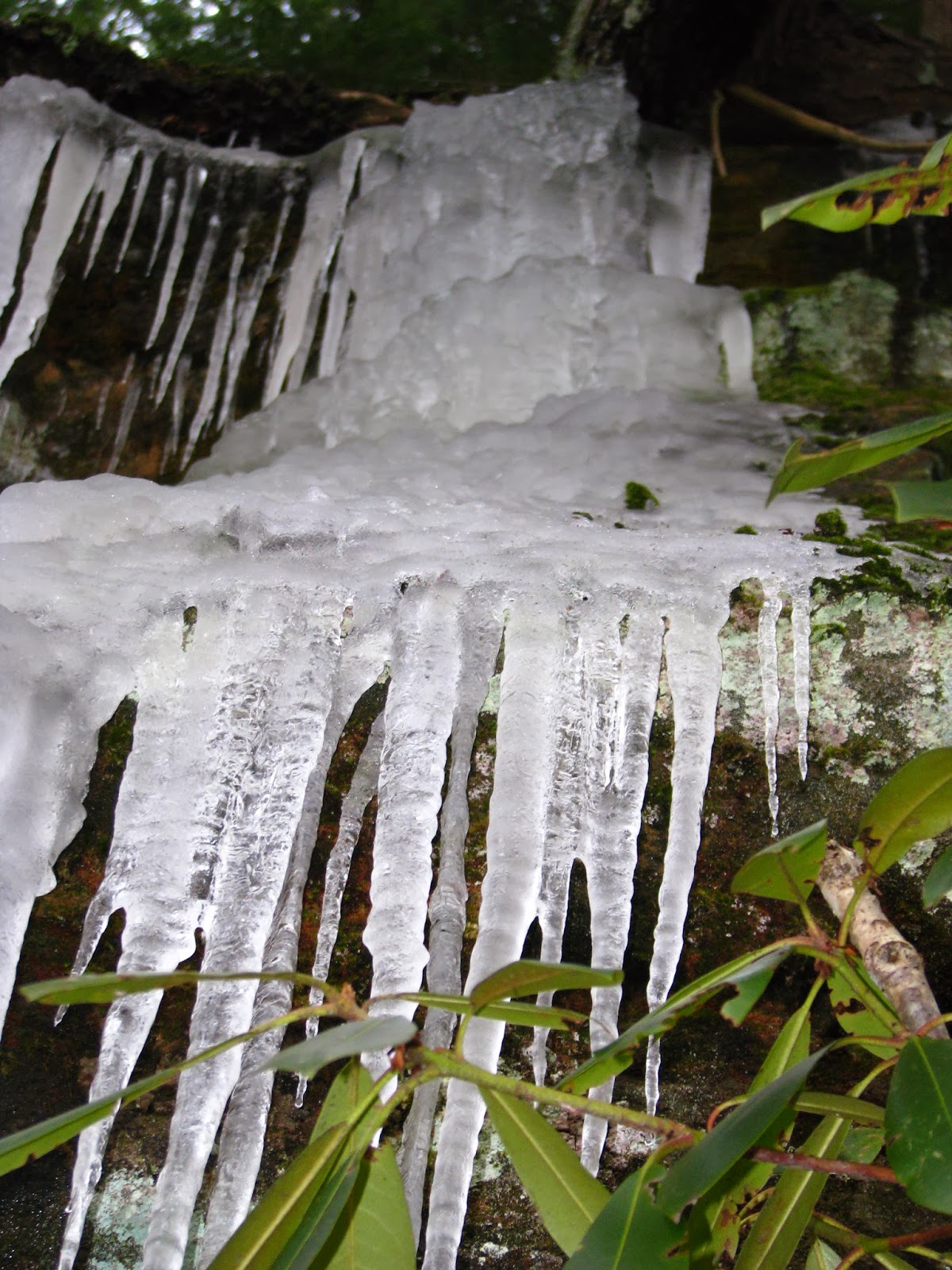
While I like to connect Creation with scriptural truths, sometimes it's nice to go out into Creation just to enjoy the beauty of it. Winter provides a unique opportunity to view Creation in a different light. My youngest daughter and I went out this afternoon to view winter in all of its splendor in Clear Creek Metro Park just south of Lancaster. There was no shortage of icy stalactites and natural black and white shots thanks to a recent snow. Creation always looks so clean in the winter; all of the roadside trash hidden under a blanket of snow.
Let me encourage you to get out and enjoy the beauty of Creation in its wintery wardrobe!
Monday, January 13, 2014
A Season of Rest Part 2
I have been learning lately a lot about the 'resting period' that I spoke of in my last blog. Creation is designed with resting periods, for organisms to slow down and rejuvenate I had always thought that most butterflies overwintered in the pupa or chrysalis stage. This would make sense. The pupa in a way is a resting stage, being unable to move, at least unable to cover distances. The pupa stage for many creatures can wiggle, which is a little freaky when you see it, but they cannot run away, fly away, etc. And of course, winter is the natural season for a resting stage. With the cold as debilitating as it is, it is difficult to move the life cycle very far forward in sub-zero temperatures.
However, in the past few weeks I have learned several butterfly species actually overwinter in the larva, or caterpillar, stage. Pictured below is the Great Spangled Fritillary. These fritillaries spend the winter as very early instar caterpillars, meaning very small caterpillars, perhaps only a few millimeters in length. The caterpillars seek shelter in the deep cracks of tree bark. Once the weather begins to warm in the spring they will crawl down the side of the tree to feast upon violets on the forest floor.
The caterpillars of other butterfly species, for example satyrs and grass skippers, will overwinter buried within the stems of the grasses that they will feed upon in the spring. Of course, these overwintering caterpillars do not feed, but simply bide there time until the weather warms.
How are you using your resting period? Creation was designed to meet all of our needs. One of those needs is rest. Take advantage of God's planning for your rest!
Monday, January 6, 2014
A Season of Rest
As I sit in my living room, wearing my Mexican blanket and toboggan, I have opportunity to reflect. The weather outside is brutal from the human perspective; 5 degree air temperature with a wind chill around -20 degrees. Snow covers the ground. My furnace is set at 60 degrees in an attempt to save money on natural gas, hence the reason for the blanket and the stocking cap. Yet, this brutal season is all by design (in my opinion).
Frequently, living in a capitalist country, there is a sense that we have to constantly be Go, Go, Go. My employer is open today, hoping that every school in Ohio being closed will create opportunities for admission paying visitors. We do not let bad weather stand in the way of generating revenue. Fortunately today is a scheduled day off for me.
Instead, I view days like today, and seasons like the Midwestern winter, as opportunities for rest. Creation needs an opportunity to rest. Constantly being in Go mode weakens us and makes us more susceptible to disease. Creation is the same way. In the Midwest, that resting stage for Creation in winter. The trees lose their leaves and go dormant. The above ground portions of perennials and grasses turn brown and wither away. The animals seek shelter in caves and hollow trees. Aquatic creatures retreat to the warmest parts of their water body. All of these organisms are seeking their rest, as intended, waiting for more favorable conditions in spring.
In the desert southwest, the season of rest is summer, when air temperatures top 110 degrees. Trees lose their leaves. Animals and insects find shaded hideaways to ride out the heat until the cooler nighttime arrives.
It would seem that us humans are the only ones who have not figured out that we need a season of rest as well. We scurry around like headless fowl, trying to make money for ourselves or our employers, totally blinded to the fact that God created the world to have times for rest and rejuvenation.
My plan, which has already been implemented, is to take tomorrow off as well. I am not a doctor, a police officer, or an EMS technician. For there is nothing so critical that my presence is needed, beyond a divinely inspired day of rest!
Wednesday, August 21, 2013
Confirmation
![]() |
| Bluegill |
![]() |
| Pandora Sphinx moth |
![]() |
| Androgeus Swallowtail |
![]() |
| Peppermint |
"33 He described plant life, from the cedar of Lebanon to the hyssop that grows out of walls. He also taught about animals and birds, reptiles and fish."
1 Kings 4:33
The above scripture is talking about King Solomon. We all know that Solomon was the wisest man in the world, filthy rich, and had more wives than any man could hope to have, or probably want to have. The one thing I never knew about Solomon until the other day however was that he was also a naturalist.
Frequently I have felt like a fish-out-of-water as a nature enthusiast in the Christian crowd. So many Christians seem to think that God's instruction to have dominion over the earth meant to do whatever they please to the earth, regardless of the consequences. The idea of somebody approaching the earth with a sense of stewardship and scientific interest was usually labeled as worshiping the earth rather than God.
For a long time I felt a sense of internal conflict about this. I really felt that God had hard-wired me to have an inquisitive nature about creation. At the same time, I had heard many a sermon and many a passing comment that nature enthusiasts were evil and wrong and worshiping the wrong thing.
It wasn't but a few years ago that I finally decided that yes, God had hard-wired me this way, that God had built within me a genuine desire to learn as much as I could about creation. God had created me to want to learn the names of all of the different plants and animals, and to learn the different stories that made each member of creation special and unique, just like me.
I am so pleased to learn that Solomon was given the same interest in the natural world as I. I feel like I am in good company, and I feel like it is confirmation that my interest in creation is in fact from the Lord.
Monday, July 29, 2013
Colors of the Rainbow
Today was a very colorful day as I visited a place called Hope Furnace. Hope Furnace is a historic site where people nearly a century ago would smelt iron ore. Adjacent to the site is a swamp and stream, which if you go far enough eventually attaches to Lake Hope.
I guess I find it a little ironic that I saw the colors of the rainbow today (or near to it) at a site that is largely covered by water. Afterall, God's promise that he would never flood the earth again is manifested by the rainbow.
The colors of the rainbow are red, orange, yellow, green, blue, indigo, and violet. Representing those colors are the red of the Cardinal Flower, the orange of the Sleepy Orange butterfly (the upper wing surface is very orange!), the yellow of the Wingstem (complete with bumble bee!), the green of the not yet ripened Sensitive Fern sporophyll, the blue of the Monkey Flower, and the indigo/violet of the Purple Fringeless Orchid. I threw in the pink Sweet Water Lily just for fun!
In all honesty, I didn't realize I had all these great colors today until I started looking over my photos tonite. I have to wonder how many really interesting things I miss because my mind is instead on hurrying to get home, or the fact that I forgot to stop at the post office this morning, or that my knee hurts. I need to do a better job of clearing all that other garbage out of mind, and focusing on the beauty that God has give us. Do you need to do the same?!
Thursday, July 11, 2013
Praising God part 2
![]() |
| The larva that fell from the sky! |
![]() |
| Rhododendron |
As I photographed the beautiful, white-flowered shrub, my children sat down on the moss covered ground and patiently waited for me. As they sat, a caterpillar fell out of the sky and landed on my son's pants leg. Actually, I suspect it was a sawfly larva rather than a butterfly caterpillar. But anyways, I looked up, curious what kind of tree the critter had fallen from.
Above rose a fairly large tree, perhaps 40 feet tall, with toothed, pointy leaves and smooth bark. Well, there are several different tree species in southern Ohio that fit that description. The one way to tell for sure was to scratch a twig and smell it. And when I smelled the scratched twig, I was reminded of one of my favorite smells in Creation, that of Sweet Birch. Sweet Birch has a very strong wintergreen smell. I need to research if it is safe to chew on the twigs, because if it tastes like it smells, the flavor would be heavenly.
Out west, my favorite smell was the smell of an approaching rain storm. In Arizona, as the Creosote bush gets wet it releases a very distinct smell. The smell is then carried ahead of the storm. So when one smelled creosote, you knew rain was on the way. Not only is creosote an appealing smell, it also carried an uplifting message. While in Ohio we sometimes loathe the rain, especially when it falls everyday for three weeks in a row like it has recently, in Arizona, rain is rejoiced. The smell of creosote meant something wonderful was about to happen.
What are your favorite smells from Creation? If you do not have a favorite smell, then you probably need to spend more time in Creation!
Wednesday, June 19, 2013
Fingerprint of God
The other day I took a trip to Shawnee State Forest in southern Ohio in search of flowers for my One Thousand Flowers project. In a damp shady spot along Forest Road 5, I found the plant pictured above. I knew it was a mint of some sort, but otherwise it was unfamiliar to me.
When I returned home later that night, I got busy trying to identify the plant. It turned out to be Hedge Nettle (Stachys cordata). While I had been in the field, I had not really paid attention to the purple pattern on the flower, probably because my eyes aren't so good now-a-days. But as I looked at the photos something suddenly struck me, the purple pattern on the lower lip of the flower looked like an angel. The lower portion of the design looked like the angel's legs, with the wings reaching up to the top of the petal. Between the wings, at the throat of the flower, is a pinkish blush (actually a series of very short pink lines), that looks like the angel's head.
In all honesty, I am the type of guy who doesn't normally notice shapes or designs in random things. I am NOT the kid who laid on his back, staring at the sky, looking at the shapes of the clouds. My mind generally doesn't work that way. That is why I found it odd that I so quickly noticed this design. As I write this, the song "Entertaining Angels" by the Newsboys is running through my mind.
I am convinced that God leaves little clues, little fingerprints behind, to remind us of his glory and handiwork. Let me encourage you to take some time to go out into creation, and look for these fingerprints that God has left for us!
Subscribe to:
Posts (Atom)